
Introduction – When Confusion Feels Like Heartbreak
One day they text you “goodnight ❤️”, and the next—silence.
Days later, they send a meme like nothing happened. You stare at the screen, half angry, half relieved, and fully confused.
If you’ve ever been through this, you’re not imagining things. This isn’t ordinary ghosting. It’s Ghostlighting in Gen Z — a new kind of emotional manipulation where someone disappears and then reappears, pretending nothing happened, sometimes even making you feel guilty for noticing their absence.
It’s the most confusing breakup you’ll ever experience because it doesn’t even feel like a breakup — more like an emotional fog that never clears. And for Gen Z, living in a digital world of constant DMs and disappearing acts, this silent pain has become far too common.
Section 1: What Exactly Is Ghostlighting?
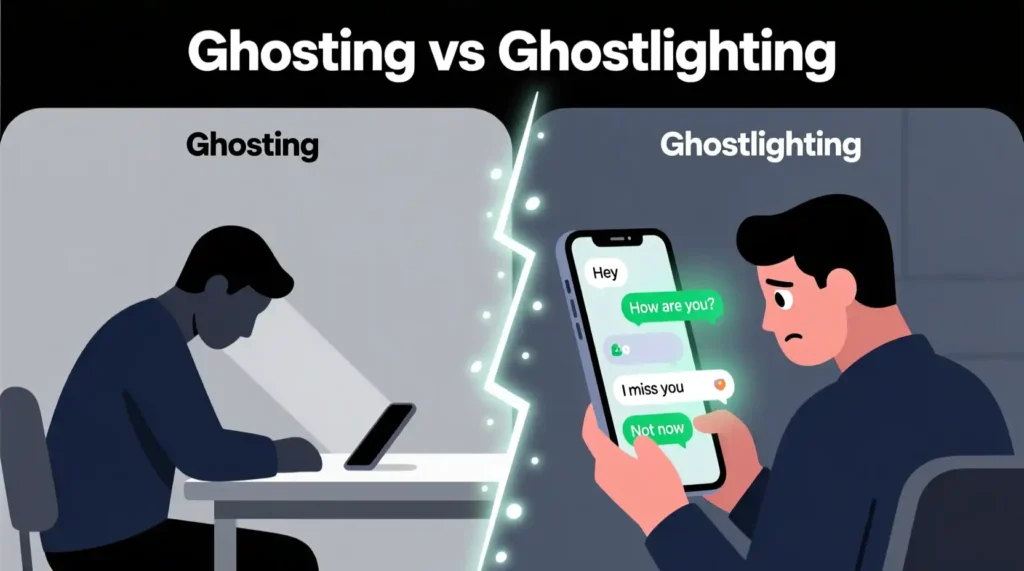
Ghostlighting blends ghosting (sudden disappearance) with gaslighting (making you question your reality).
Imagine this: You’re talking to someone every day. You share playlists, memes, late-night thoughts. Then, without warning — nothing. No replies. You refresh your chat like a ritual, wondering if they’re just busy. Weeks later, they pop up with, “Hey, been swamped. You good?”
Now you’re torn between relief and anger. They act like nothing happened, and somehow, you end up apologizing for “overreacting.”
That’s ghostlighting — not just silence, but confusion packaged as carelessness.
It’s trending on TikTok under #ghostlightingstories, where Gen Z users share how they were left hanging and then guilt-tripped into believing they were the problem. On Reddit, threads about “emotional gaslighting in texting culture” are full of similar pain.
Section 2: Why Gen Z Is More Vulnerable to Ghostlighting
We live in the most connected yet emotionally detached generation ever. For Gen Z, love happens through blue bubbles, Snapchat streaks, and DMs that can vanish overnight.

Here’s why we fall for ghostlighting so easily:
- Instant highs, sudden lows: Online dating gives dopamine hits — fast replies, likes, voice notes — that make emotional withdrawal feel like a crash.
- Avoidance culture: Many fear confrontation. Instead of saying “I’m not feeling it anymore,” they just disappear.
- The “chill” mask: We confuse emotional numbness for maturity. “I don’t care” becomes a badge of honor.
- Algorithm heartbreak: Even after ghosting, their face keeps showing up — your “For You” page becomes your “For Pain” page.
It’s a loop of connection and confusion. And the more digital your bond, the harder it is to see where emotional manipulation begins.
Section 3: The Psychology Behind Ghostlighting
Let’s talk about what’s really going on underneath.
From the Ghostlighter’s Side
Sometimes they’re not villains — just emotionally avoidant people afraid of guilt or accountability. Ghostlighting lets them control the story. They leave when it’s inconvenient and return when they crave validation.
It’s not love; it’s power.
From the Victim’s Side
When you’re ghostlighted, your brain goes into loop mode. You replay conversations, reread texts, analyze emojis. You tell yourself, “Maybe I was too much,” or “Maybe I imagined the distance.”
But you didn’t. Studies show that breakups can disrupt self-identity and clarity, making you doubt your instincts. Ghostlighting multiplies that confusion — you’re left trying to heal from something that never had closure.
I remember once being ghostlighted by someone I met online. They’d vanish for days and then show up with “missed you” messages. Every time I started detaching, they’d reappear — like emotional gravity pulling me back. It wasn’t love; it was control disguised as care.
Section 4: Signs You’re Being Ghostlighted
If these feel familiar, you’re not overthinking — you’re being manipulated.
- They vanish mid-conversation, then reappear like nothing happened.
- They downplay your hurt with “You’re too sensitive.”
- They rewrite the story: “You were the one who pulled away.”
- They act warm again, then cold, keeping you unsure.
- You constantly question if you’re the problem.
The cruel part? They make you crave their validation while breaking your trust.
Section 5: How to Heal from Ghostlighting
Healing starts when you stop seeking answers from the person who confused you.

- Acknowledge your feelings. You’re not weak for missing them; you’re human.
- Stop chasing closure. People who ghostlight can’t give clarity they don’t have themselves.
- Write the timeline. Seeing it on paper helps you see the truth your emotions hide.
- Block if you must. Digital silence is self-respect, not immaturity.
- Rebuild slowly. Trust your gut again. Healing takes time, but you’ll get there.
When I finally stopped replying to that “Hey stranger” text, it felt heavy for a week — then lighter for a lifetime.
Section 6: Why Ghostlighting Hurts More Than Normal Ghosting
Normal ghosting gives you silence; ghostlighting gives you confusion.
It warps your sense of reality — one minute you’re close, next minute invisible, then blamed for being distant.
It’s emotional whiplash.
Experts note that heartbreak affects how we see ourselves — it can distort self-worth and identity. Ghostlighting doubles that effect because it turns trust into self-doubt.
You don’t just lose someone; you lose your ability to believe your own feelings.
Section 7: Moving Forward — Emotional Literacy for Gen Z

After you’ve been ghostlighted, the hardest thing isn’t forgetting the person — it’s learning to trust your own perception again. The messages, the pauses, the “maybe I’m crazy” moments all live rent-free in your mind.
But the truth is, emotional literacy — the skill of naming, feeling, and managing emotions — is your way out. It’s what turns pain into power.
I remember journaling one night after my own ghostlighting experience. I wrote, “I don’t know what hurts more — that they left, or that I kept forgiving the confusion.” That sentence changed everything. It helped me see that my healing wasn’t about them coming back; it was about me coming home to myself.
Here’s how Gen Z can start moving forward with emotional clarity:
1. Choose Honest Conversations Over Comfortable Silence
Ghostlighting thrives where honesty dies. Saying “I’m not ready for this” may feel awkward, but it saves both people from confusion later. It’s okay to disappoint someone — just don’t disappear on them.
2. Unlearn the ‘Cool’ Culture
Being “chill” about everything has made real connection rare. Vulnerability isn’t weakness; it’s courage. Tell people what you feel instead of pretending you don’t care.
3. Heal Without Needing Revenge
You don’t have to prove your worth by glowing up for their attention. Prove it to yourself. Your silence, peace, and growth are the best closure you’ll ever get.
4. Redefine Boundaries as Self-Respect
Boundaries aren’t walls; they’re windows with locks. You decide who gets to open them. Protect your energy like it’s gold — because it is.
Section 8: Turning Ghostlighting Pain into Growth
When you finally accept that Ghostlighting in Gen Z is not a reflection of your value but of someone else’s immaturity, the fog begins to lift.
Start with small acts of self-respect:
- Don’t stalk their profile; mute or block if needed.
- Reclaim your mornings — stop checking your phone first thing.
- Channel your emotions into something creative: writing, music, workouts.
- Connect with friends who make you feel seen, not questioned.
Every time you choose clarity over confusion, you’re teaching your heart what real love should feel like — calm, consistent, and kind.
Section 9: What Healthy Love Looks Like for Gen Z
We talk so much about the pain of modern dating, but not enough about what healthy actually feels like.
Real love doesn’t make you anxious. It doesn’t vanish when things get hard. It shows up — even in small ways — consistently.
Healthy relationships:
- Communicate without guilt.
- Respect space without using it as punishment.
- Take accountability instead of rewriting stories.
If you’ve been ghostlighted, remember: the right person won’t confuse you. They’ll bring peace, not puzzles.
Mini Story — The Message I Never Sent
A few months after my ghostlighting heartbreak, I drafted a message:
“You really messed me up, you know. I kept blaming myself for everything.”
I never sent it. Instead, I wrote another one in my notes app:
“Thank you for teaching me what I’ll never tolerate again.”
That message was for me, not for them. That’s when I realized — the closure we crave often comes from the mirror, not the chat box.
Section 10: Rebuilding Self-Trust After Ghostlighting
Trust is like glass — once cracked, it’s never the same, but it can still hold light.
Here’s how to rebuild it:
- Listen to your instincts. If something feels off, it usually is.
- Practice emotional patience. Healing is not linear; it’s layered.
- Forgive yourself for staying too long. Confusion isn’t weakness; it’s hope misplaced.
- Seek support. Talk to a therapist or journal daily. Writing helps organize emotional chaos.
Slowly, you’ll start to notice a shift. The same songs that once hurt will sound like lessons instead of losses.
Conclusion — The Final Word on Ghostlighting in Gen Z
Ghostlighting in Gen Z isn’t just a dating trend; it’s an emotional epidemic born from fear of honesty and addiction to validation. It leaves people questioning their worth, replaying messages, and doubting their own hearts.
But here’s the truth you need to hold on to:
You were never too much. You were just too genuine for someone who wasn’t ready to meet you at that level.
Every time you stop replying to confusion, every time you choose clarity over chaos, you are rewriting the script for what love looks like in this generation.
So if you’re healing from ghostlighting right now, take this as your sign — you’re not broken. You’re becoming emotionally fluent in a world that still speaks avoidance.
And that, my friend, is your real glow-up.
Disclaimer: This post is for informational and emotional support purposes only. Every relationship is unique, and this is not professional legal, medical, or mental health advice. Read our full disclaimer.
Affiliate Disclosure: Some links in this post may be affiliate links. If you make a purchase through them, I may earn a small commission at no extra cost to you. Learn more here.
Pingback: why Gen Z keeps texting confusing people Who Confuse Them (The Truth) - Love and Breakups
Pingback: dating apps for 30 plus singles | What Really Works After 30 - Love and Breakups
Pingback: Why Dating Feels Impossible Right Now: in 2025? - Love and Breakups